Sunday, April 26, 2015

The Unit Root of the Matter: Is it Demand or Supply?

John Cochrane responds to my piece on why there is no evidence that the economy is self-correcting with an excellent blog post on unit roots. John's post raises two issues. The first is descriptive statistics. What is a parsimonious way to describe the time series properties of the unemployment rate? Here we agree. Unemployment is the sum of a persistent component and a transitory component.
The second is economics. How should we interpret the permanent component? I claim that the permanent component is caused by shifts from one equilibrium to another and that each of these equilibria is associated with a different permanent unemployment rate. I’ll call that the “demand side theory”. (More on the data here and here and my perspective on the theory here and here).

Modern macroeconomics interprets the permanent component as shifts in the natural rate of unemployment. I’ll call that the “supply side theory”. That theory is widely accepted and, in my view, wrong. As I predicted in the Financial Times back in 2009, "the next [great economic idea] to fall will be the natural rate hypothesis". 

Friday, April 24, 2015

Beyond 1950's Economic Theory: Nonlinearity, Multiple Equilibria and Sticky Prices

David Glasner has a very nice post on Price Stickiness and Economics with great comments from Rajiv Sethi,  Richard Lipsey and Kevin Donoghue among others. David reacts to a post from Noah Smith: this is all classic stuff

 
Here is David
While I am not hostile to the idea of price stickiness — one of the most popular posts I have written being an attempt to provide a rationale for the stylized (though controversial) fact that wages are stickier than other input, and most output, prices — it does seem to me that there is something ad hoc and superficial about the idea of price stickiness and about many explanations, including those offered by Ball and Mankiw, for price stickiness. I think that the negative reactions that price stickiness elicits from a lot of economists — and not only from Lucas and Williamson — reflect a feeling that price stickiness is not well grounded in any economic theory.

Thursday, April 16, 2015

There is No Evidence that the Economy is Self-Correcting (Very Wonkish)

David Andolfatto asks in a twitter exchange for evidence that deviations of GDP from trend are non-stationary. Here is the raw data. Figure 1 is the residual from a regression of the log of real GDP on a constant and a time trend for quarterly US data from 1955q1 through 2014q4. I will refer to this series as "X".
Figure 1: X = Log of Deviation of Real GDP from Trend

Table 1 reveals the regression of X on itself lagged and on a constant. Remember that these data describe deviations from trend so persistence reflects potentially permanent deviations from the trend growth path. Notice that the coefficient on lagged X is 0.996. That of course, does not establish that the data has a unit root. 

Monday, April 13, 2015

New Solutions to Old Problems

There was an interesting exchange over the last couple of days between two of my favorite bloggers; Frances Coppola, aka Femina Spectabilis, and Brad DeLong, aka Distinguitur Oeconomicarum. Frances delivered a talk at my alma mater,  Manchester University, on the need to use non-linear models and to recognize the importance of multiple equilibria. Brava! Brad Delong, over at Equitable Growth, takes umbrage at Frances’ charge and rushes to the defense of his former teacher, Olivier Blanchard, aka Nobilis Vir. 


Here is Frances at full tilt

… some of the most influential people in macroeconomics have spent their lives developing theories and models that have been shown to be at best inadequate and at worst dangerously wrong. Olivier Blanchard’s call for policymakers to set policy in such a way that linear models will still work should be seen for what it is – the desperate cry of an aging economist who discovers that the foundations upon which he has built his career are made of sand. He is far from alone.

Sunday, March 8, 2015

Yes David: Unemployment is Sometimes Involuntary

My pal David Andolfatto doesn't like it when I say that some unemployment is involuntary. Here is my response:


David
I am happy with the way you characterize my beliefs in the first paragraph of your blog. Unemployment is clearly not Pareto optimal.  Everything you say after that is at best misleading and at worst dismissive of everything we (at least some of us) learned from Keynes. 

The idea of involuntary unemployment was introduced by Keynes in the General Theory. But you already knew that. It is defined as a situation where (in modern language) the ratio of the marginal disutility of work to the marginal utility of consumption is not equal to the real wage. That seems a pretty accurate description of the equilibrium outcome of labor search models.

Saturday, March 7, 2015

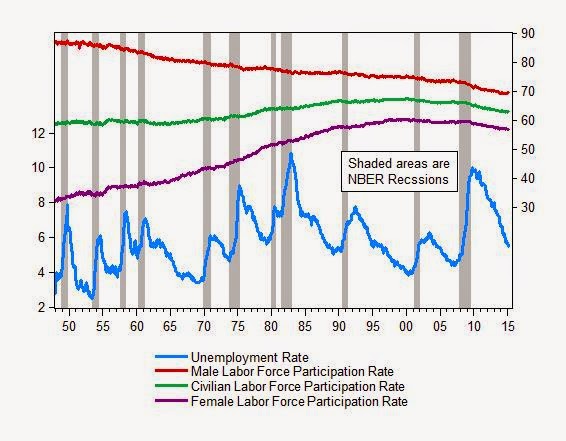
Labor Force Participation is Secular: Unemployment is Cyclical!

Updated data at the request of Andrew Sentence on participation and unemployment in the U.S.  
Business cycles are about unemployment; not about changes in the participation rate.
(c) Roger E. A. Farmer March 2015
See my twitter posts today on this topic. 

If people choose to look for a job; that's their business. If people can't find a job; that's our collective business as a society.
Participation is a voluntary choice.  Unemployment is not. 
The idea that unemployment is voluntary is classical nonsense.
Anybody want to explain to me why they think labor force participation is a cyclical phenomenon?
Participation is not cyclical! Unemployment is!  
The secular trend in participation dwarfs the cyclical movement. That's an important fact! 
Follow me on twitter @farmerrf 

Sunday, February 15, 2015

Sam and Janet go to College


My reading list on the overlapping generations model has already generated some questions. Rather than respond in the comment section to each question individually, I will answer these questions in a new post. Here goes.

In a comment on my previous blog Brian Romanchuck has a “good grounding in mathematics” and he “understands the [overlapping generations] models.” He is my ideal reader. Brian raises a number of points that may be shared by others with a similar background. If you also have a good grounding in mathematics and you think you understand the models: this post is for you.