Sunday, March 8, 2015

Yes David: Unemployment is Sometimes Involuntary

My pal David Andolfatto doesn't like it when I say that some unemployment is involuntary. Here is my response:


David
I am happy with the way you characterize my beliefs in the first paragraph of your blog. Unemployment is clearly not Pareto optimal.  Everything you say after that is at best misleading and at worst dismissive of everything we (at least some of us) learned from Keynes. 

The idea of involuntary unemployment was introduced by Keynes in the General Theory. But you already knew that. It is defined as a situation where (in modern language) the ratio of the marginal disutility of work to the marginal utility of consumption is not equal to the real wage. That seems a pretty accurate description of the equilibrium outcome of labor search models.
Saturday, March 7, 2015

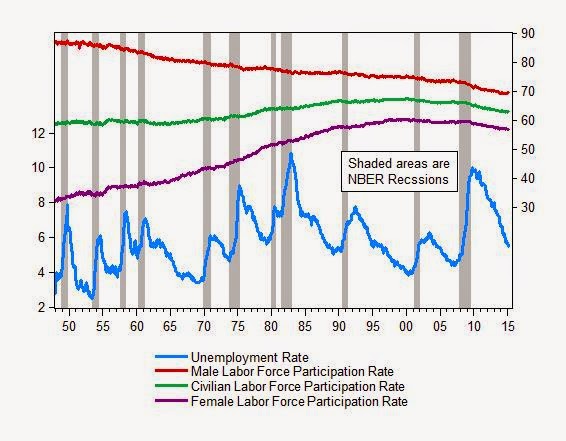
Labor Force Participation is Secular: Unemployment is Cyclical!

Updated data at the request of Andrew Sentence on participation and unemployment in the U.S.  
Business cycles are about unemployment; not about changes in the participation rate.
(c) Roger E. A. Farmer March 2015
See my twitter posts today on this topic. 

If people choose to look for a job; that's their business. If people can't find a job; that's our collective business as a society.
Participation is a voluntary choice.  Unemployment is not. 
The idea that unemployment is voluntary is classical nonsense.
Anybody want to explain to me why they think labor force participation is a cyclical phenomenon?
Participation is not cyclical! Unemployment is!  
The secular trend in participation dwarfs the cyclical movement. That's an important fact! 
Follow me on twitter @farmerrf 

Sunday, February 15, 2015

Sam and Janet go to College


My reading list on the overlapping generations model has already generated some questions. Rather than respond in the comment section to each question individually, I will answer these questions in a new post. Here goes.

In a comment on my previous blog Brian Romanchuck has a “good grounding in mathematics” and he “understands the [overlapping generations] models.” He is my ideal reader. Brian raises a number of points that may be shared by others with a similar background. If you also have a good grounding in mathematics and you think you understand the models: this post is for you.


Saturday, February 14, 2015

The Great Blog Debate about Debt: A Reading List


I applaud everyone who has weighed in on the Great Blog debate about debt (Simon,  Bob,  me, and others too numerous to link. All of the issues that have been raised on Nick's blog were the topic of frontier research in economics journals in the 1950s -- 1970s.  Nick has links to earlier posts here.


The paper that started all of this (at least in the English speaking world) was by Paul Samuelson. "An exact consumption-loan model of interest with or without the social contrivance of money", Journal of Political Economy 1958, Vol 66 No. 6. The French lay claim to an earlier version by Maurice Allais, but that's another story. 

Samuelson's paper was a revelation to economists because it provided an example where markets don't work. In Samuelson's example, there is an equilibrium, (people optimize taking prices as given and all markets clear) that can be improved upon by a government institution. Samuelson's paper is a good starting point for those who would like to read more about this.

Monday, February 9, 2015

Sam and Janet Learn about Debt

In a recent post on the (non)-importance of debt buildup worldwide, Antonio Fatas makes the point that debt is not necessarily a problem. While I agree with that statement: a great deal hinges on the qualification “not necessarily”.  

Paul Krugman goes further than Antonio. According to Paul debt is “money that we owe to ourselves”. That is at best misleading and at worst;  false. Money is money we owe to ourselves. Debt is money that some of us owe to others. 

Saturday, February 7, 2015

Lessons from the Great Galactic Depression

A long time ago, in a galaxy far far away, there were two planets orbiting a star, not unlike our own sun.  The inhabitants of these planets share a common ancestry but, over the years, they have developed somewhat different temperaments. 


The names of these planets are difficult to pronounce in English, but we will call them Nordus and Sudus. The name of their star is Sol.

Nordus, being further away from Sol, has a colder climate than Sudus and its inhabitants are known to be frugal and patient. The Sudusians, in contrast, live for the moment. Using the language of economics, earth people would say that the Sudusians have a higher rate of time preference. 


Wednesday, January 21, 2015

Why the ECB Should Take More Risks

Mrs. Merkel and Mr. Schäuble are worried. The ECB is planning to buy the sovereign debt of its member states and Mr. Schäuble doesn't trust his southern European partners. He thinks that Portuguese, Spanish and Italian debt is risky and he knows that Greek debt is.

Bankers are supposed to be boring. And central bankers are supposed to be boring in spades. What would happen if the Fed were to bet the farm, buying shares in an internet start-up that subsequently goes bust? The public purse would be on the hook for the loss. At least, that’s the theory. That theory is wrong.

The central banking business plan is a money-spinner beyond a venture capitalist’s wildest dream. Buy an asset, any asset, and pay for it by issuing little pieces of colored paper. Collect the interest payments and dividends from the assets and use them to pay for your house, your car and a holiday in Spain. If you happen to be the central bank of a sovereign state, pay the interest and dividends to the treasury to help reduce the tax bill of your citizens.

Does it matter which assets you buy? Conventional wisdom says yes. A central bank should buy safe assets, typically promises issued by its own national government that will never fall in value. The Fed buys T-bills on the private market. The Treasury pays the interest and principal to the Fed, and the Fed turns around and pays them straight back to the Treasury. The point of all of this is to keep enough of the little pieces of colored paper passing from one person to another to “oil the wheels of trade”.